Link

/* Style Definitions */
table.MsoNormalTable
{mso-style-name:”Table Normal”;
mso-tstyle-rowband-size:0;
mso-tstyle-colband-size:0;
mso-style-noshow:yes;
mso-style-priority:99;
mso-style-qformat:yes;
mso-style-parent:””;
mso-padding-alt:0cm 5.4pt 0cm 5.4pt;
mso-para-margin-top:0cm;
mso-para-margin-right:0cm;
mso-para-margin-bottom:10.0pt;
mso-para-margin-left:0cm;
line-height:115%;
mso-pagination:widow-orphan;
font-size:11.0pt;
font-family:”Calibri”,”sans-serif”;
mso-ascii-font-family:Calibri;
mso-ascii-theme-font:minor-latin;
mso-fareast-font-family:”Times New Roman”;
mso-fareast-theme-font:minor-fareast;
mso-hansi-font-family:Calibri;
mso-hansi-theme-font:minor-latin;}

Thank you Dr Verner Wheelock for the extensive critique of the reports . The Cochrane reports analysis was heroic and well structured. We had a huge debate about them at the time on THINCS (www.thincs.org).

For my part I shy away from statistical analysis which doesn’t include ‘All Cause Mortality’ figures. The reason being that failure to look at all the non-cardio deaths and drop-outs from trials cleans and amplifies the apparent benefits of Statins. This means we can never know the Numbers Needed to Harm NNH side of the medication.

My first ever review paper (G Wainwright et al., 2009) looking at the clinical impact of cholesterol lowering in all non-cardiovascular organs, was seminal in that it pointed up a fundamental flaw in the whole statin concept i.e. Cholesterol is vital and inhibiting its production is destined to create a wide and varied set of Adverse Events in statin users in the longer term.  That is why ‘all cause mortality’ data is not made available (caveat emptor).

In our second review paper(Seneff et al., 2011)  we became aware of the fact that LDL/HDL ratios were associated with LDL consumption by organs and not production by the liver. The whole LDL argument had been inverted.  If LDL is damaged by glycation,  LDL goes up and HDL falls.  The liver’s glycated-LDL is unused and the corresponding HDL return to the liver does not happen.
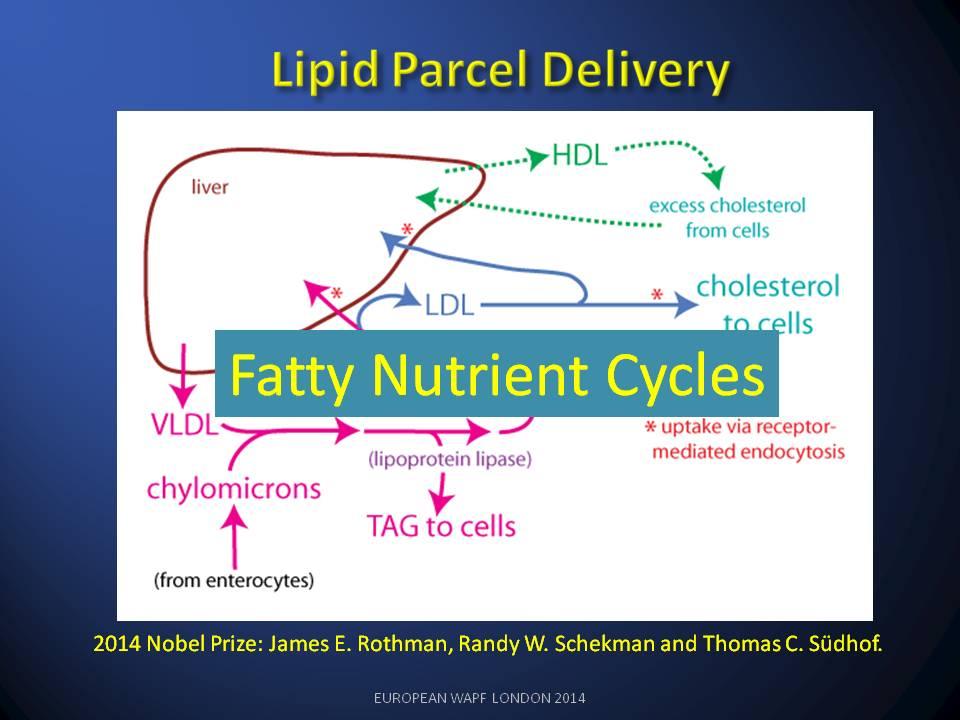
LDL HDL Cycles

How such a fundamental part of the lipid nutrition cycle could be missed is hard to understand. Obsession with statins and statin finance has done immense harm to cardio-medicine and I believe we are seeing the start of a major NICE scandal as the BMA object to the guidance.

G Wainwright, L Mascitelli, and M Goldstein (2009). Cholesterol-lowering therapy and cell membranes. Stable plaque at the expense of unstable membranes? Arch. Med. Sci. 5, 289–295.

Seneff, S., Wainwright, G., and Mascitelli, L. (2011). Is the metabolic syndrome caused by a high fructose, and relatively low fat, low cholesterol diet? Arch Med Sci 7, 8–20.

109. Cochrane Collaboration Evaluates Statins for Primary Prevention of Heart Disease | Verner’s Views

Link

Anecdote: A  diabetic clinician told me she had noticed that when patients had good control of their hba1c (an indicator of sugar-damage in blood ) their ‘cholesterol’ score also improved.

Every molecule of cholesterol in the body is known to be identical to every other. 

The Good/Bad labeling of cholesterol is extremely unscientific and unhelpful, and that is a matter of scientific fact.

How were  intelligent, well educated, medical professionals  persuaded to popularise this ‘Good ‘ cholesterol versus  ’Bad’ cholesterol idea?

The unscientific phrase ‘Bad Cholesterol’ is a misleading description of damage to the ’lipid transport system ‘, whose basic function was described by the Nobel Prize winners James E. Rothman, Randy W. Schekman and Thomas C. Südhof.  (Awarded “for their discoveries of machinery regulating vesicle traffic, a major transport system in our cells”.

The lipid transport system is used by the body to deliver essential supplies of fat, cholesterol, and other fat-soluble nutrients.

The lipid transport system is able to repair and recycle, but can be progressively overwhelmed by the damage accumulated over several decades.

This  damage to the lipid system is caused by oxidation and glycation: the result of excessive consumption of refined sugars (in particular High Fructose syrups).

It is not ‘bad cholesterol’ but sugar-damage to the proteins that make the lipids available to the organs of our body.

Unconsumed ‘damaged’ ldl  in the blood is an indicator of trouble because the organs are being starved  of vital fats cholesterol and fat-soluble nutrients.

‘Bad Medicine’ prevents the liver and all other organs from making essential cholesterol   indirectly stop the supply of lipids to the blood.

Cholesterol lowering medications have a variety of very broad variety of adverse-effects, all attributable to organs being starved of fat, cholesterol and fat-soluble nutrients.

The ‘bad medicine’s do not tackle the cause of damage to the ldl –  lipids supply.

The primary cause of this ldl damage is the oxidation and glycation of the  ldl’s components.

The main dietary and lifestyle causes of ldl damage are over-consumption of refined sugars and inactivity.

The reactive sugars like fructose, found in manufactured corn syrups are particularly troublesome, because they directly attach to ldl-protein mechanisms causing a mal-function which starves the organs.

Important protective and anti-oxidant functions rely on Cholesterol and CoQ10 –  both of which  are reduced  anti-cholesterol medications. 

The unscientific use of the incorrect description ‘Bad Cholesterol’ has held back medicine for over 40 years and it is time to look at the evidence in more detail:-

“Cholesterol Lowering Therapies and Membrane Cholesterol”   Wainwright G Mascitelli L  &  Goldstein M R, Archives of Medical Science, Vol. 5 Issue 3 p289-295 2009

“Is the metabolic syndrome caused by a high fructose, and relatively low fat, low cholesterol diet?”   Seneff S, Wainwright G, and Mascitelli L Archives of Medical Science  Vol. 7 Issue 1 p8-20 2011 doi: 10.5114/aoms.2011.20598

 "Nutrition and Alzheimer’s disease: the detrimental role of a high carbohydrate diet"   Seneff S., Wainwright G., and Mascitelli L. European Journal of Internal Medicine 2011, doi:10.1016/j.ejim.2010.12.0172011

‘Good/Bad Cholesterol ‘ and ‘Bad Medicine’

Link

Link to slideshow

Excess exposure to fructose intake determines the liver to metabolize high doses of fructose, producing increased levels of fructose end products, like glyceraldehyde and dihydroxyacetone phosphate, that can converge with the glycolytic pathway. Fructose also leads to increased levels of advanced glycation end products.

The macrophages exposed to advanced glycation end products become  dysfunctional and, on entry into the artery wall, contribute to plaque formation and thrombosis.

Sugar-Damaged Proteins

Image

AGEs (Advanced Glycaemic End-products)

The other cause of sugar damage is the uncontrolled (non-enzymic) attachment of excess sugar molecules (e.g. fructose and glucose) to proteins (such as collagen, elastin and receptors) around the body.  Over time this gives rise to sugar-damaged proteins known as appropriately as Advanced Glycaemic End-products (AGEs). These AGEs cause, joints, arteries, heart, lungs and skin etc. to lose their elasticity.

The transport of the fat soluble nutrients (including vitamins A, D & E )  to all the organs of the body rely upon Lipids (fatty droplets) produced by the liver and circulating in the blood in the blood.   A simplified version of this mechanism has the liver sending large particles (LDL) to deliver the nutrients and the tissues returning smaller particles (HDL) for recycling.  The particles have apolipoproteins (APO) as labels  the to identify their destination and purpose. Matching receptors are deployed on tissues to latch onto the lipids droplets they require.   When the labels and receptors are damaged by attached sugars, the tissues cannot get the fats they require and the fats are scavenged by visceral fat cells in the abdomen.  This causes a cascade leading to a variety of AGE related diseases as we age.